Scientists turn colon cancer cells into near-normal cells
A KAIST team managed to "reverse" cancer in the lab without killing the cells.
Instead of destroying tumor cells, a Korean team got colon cancer to "step back" into a state resembling healthy cells.
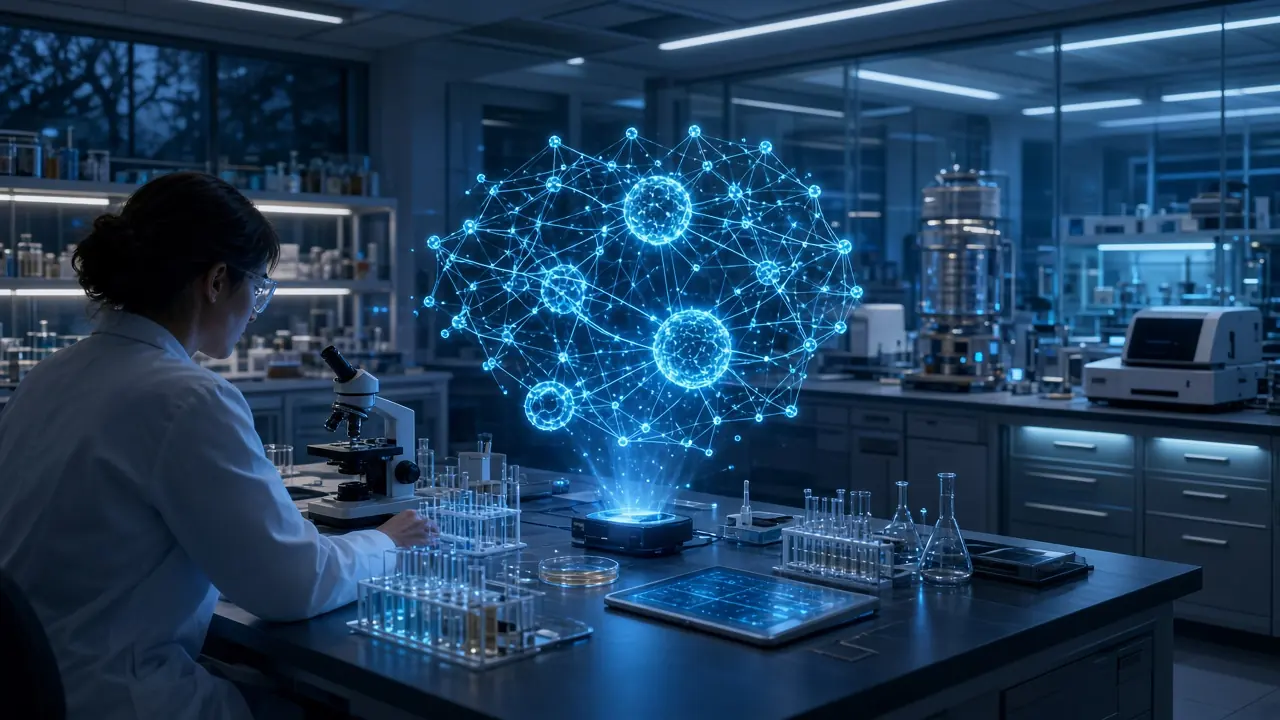
Kwang-Hyun Cho's team at the Korea Advanced Institute of Science and Technology (KAIST) started from an observation: when cells become cancerous, they regress along their maturation path. Using single-cell data from the human large intestine, they built a "digital twin" of the gene network that guides this process, a mathematical model that can be simulated.
With their tool, called BENEIN, they searched for the master switches that prevent cells from maturing into enterocytes, the normal cells of the intestine. They found three genes: MYB, HDAC2 and FOXA2. Switching them off together in three colon cancer lines reduced proliferation far more than switching them off separately, and the cells took on a genetic profile similar to normal tissue.
The effect was also seen in mice with implanted tumors, whose volume and weight decreased. The idea of reverting cancer rather than killing it could avoid side effects, although it has not yet been tested in people.
The work is signed by Jeong-Ryeol Gong, Chun-Kyung Lee, Hoon-Min Kim, Juhee Kim and Jaeog Jeon, and was published online on December 11, 2024.
Key facts
- Key genes: MYB, HDAC2 and FOXA2.
- It worked in three cell lines: HCT-116, CACO-2 and HT-29.
- Compared with data from more than 400 colon cancer patients.
- Published in Advanced Science in December 2024.
The authors believe the method could apply to other cancers; clinical trials are still needed.
Futurismo newsletter
Get the most futuristic stories in your inbox. Free.
By subscribing you agree to receive emails from Futurismo and our privacy policy. Unsubscribe anytime.Related stories

An AI-agent lab that runs DNA experiments on its own
AutoDNA, in Shanghai, designs and executes molecular experiments with minimal human intervention.
An AI designs proteins from a simple text description
The Pinal model turns a sentence into a candidate protein, although its hit rate is still uneven.
Neuralink now has 21 people controlling computers with their minds
Two years after its first implant, the Telepathy chip is adding patients in four countries.

Homo erectus fossils recovered from the seafloor in Indonesia
Remains dredged from the Madura Strait reveal a land now underwater.