Hubble finds the "missing" black hole in Omega Centauri
Seven stars moving too fast give away an intermediate-mass black hole.
Seven stars moving too fast reveal something invisible at the heart of Omega Centauri: a black hole of a very rare kind.
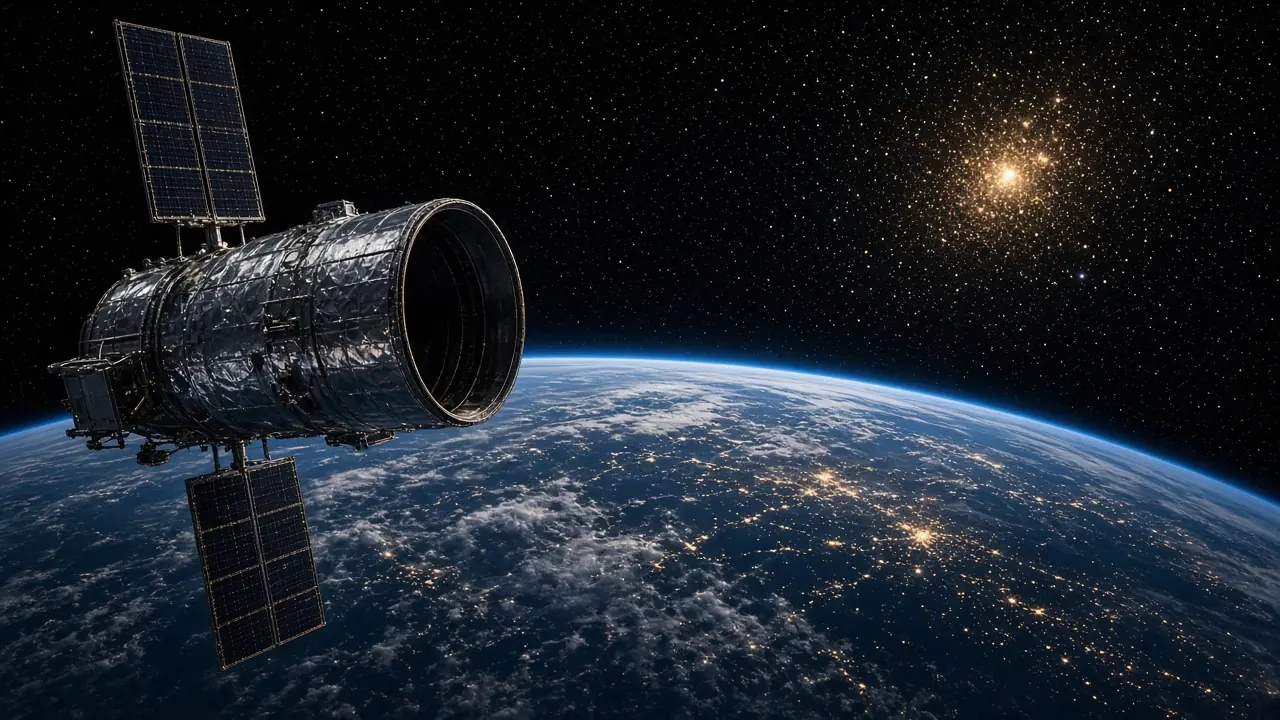
Known black holes are usually huge, like the supermassive ones at the centers of galaxies, or light, with less than 100 times the mass of the Sun. Intermediate-mass ones are rare and considered the missing link in their evolution.
An international team led by Maximilian Häberle, of the Max Planck Institute for Astronomy, reviewed more than 500 Hubble images taken over two decades, most intended for calibrating instruments. With them they built a catalog of the velocities of 1.4 million stars in Omega Centauri and found seven moving so fast they should escape the cluster. Only a very massive object can hold them: a black hole of at least 8,200 solar masses.
Earlier studies had suggested the central mass might be due to a group of stellar black holes. According to co-investigator Nadine Neumayer, this finding is the most direct evidence yet of an intermediate-mass one in the cluster, which could be the best example of its kind in our cosmic neighborhood.
Key facts
- Minimum mass: about 8,200 times that of the Sun.
- Omega Centauri holds about 10 million stars and lies 17,700 light-years away.
- If confirmed, it would be closer than the Milky Way's central black hole (26,000 light-years).
- Study published in Nature in July 2024.
The object is still a candidate awaiting confirmation, and it will help study how these black holes form and grow.
Futurismo newsletter
Get the most futuristic stories in your inbox. Free.
By subscribing you agree to receive emails from Futurismo and our privacy policy. Unsubscribe anytime.Related stories
The star cluster that is almost as old as the universe
A cluster hidden behind the dust of the galactic center may be 13.4 billion years old.

Martian dust is gentler than lunar dust, but it has risks
Spacesuit samples aboard Perseverance barely wore down over 1,645 Martian days.

The five letters of the genetic code were on asteroid Ryugu
Samples brought back by Japan's Hayabusa2 mission contain all five bases of DNA and RNA.
Hubble finds that oxygen is missing from dwarf galaxies
Supernova explosions expel more oxygen from small galaxies than models predicted.