The star cluster that is almost as old as the universe
A cluster hidden behind the dust of the galactic center may be 13.4 billion years old.
Hidden behind thick dust clouds at the center of the Milky Way, a star cluster could be 13.4 billion years old.
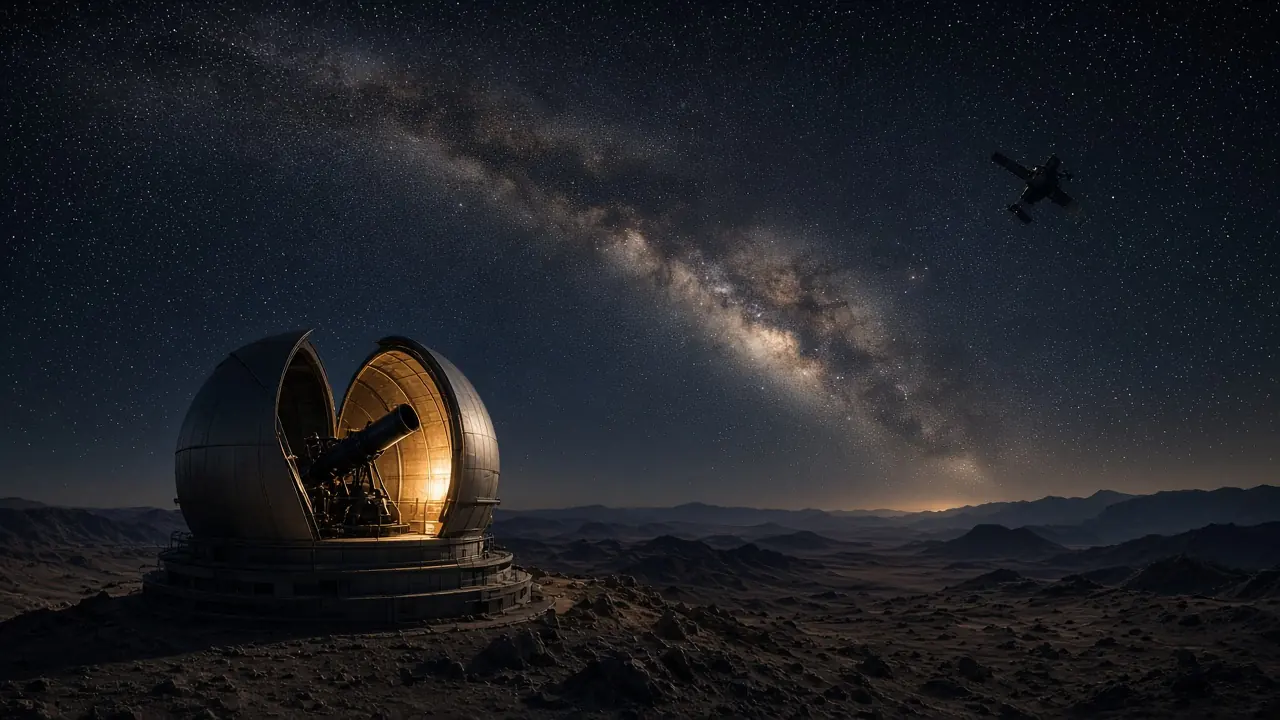
VVV CL001 is a globular cluster in the galactic bulge, recently discovered and very metal-poor, a sign of great age. Because it lies behind a veil of interstellar dust, its distance and age were highly uncertain.
A team led by J. Olivares Carvajal, of INAF's Capodimonte Observatory, used the FourStar infrared camera on the 6.5-meter Magellan Baade telescope to measure its distance, and new Hubble images, less affected by dust, to calculate its age. With two different stellar evolution models they got the same result: 13.4 ± 0.4 billion years.
Finding the galaxy's oldest cluster helps set a minimum age for the Milky Way and for the universe itself, about 13.8 billion years. Its orbit confirms it belongs to the bulge, which would link it to the earliest stages of our galaxy's formation. But the authors warn that a systematic error of about 1 billion years must be added, and that the images do not fully cover the key region of its stars' diagram.
Key facts
- Estimated age: 13.4 ± 0.4 billion years.
- Distance: 7.34 kiloparsecs (about 24,000 light-years), the most precise to date.
- Earlier studies gave it about 12 billion years.
- Accepted in Astronomy & Astrophysics.
The authors call for deeper observations to confirm whether it is the oldest cluster in the galaxy.
Futurismo newsletter
Get the most futuristic stories in your inbox. Free.
By subscribing you agree to receive emails from Futurismo and our privacy policy. Unsubscribe anytime.Related stories
Hubble finds the "missing" black hole in Omega Centauri
Seven stars moving too fast give away an intermediate-mass black hole.
Martian dust is gentler than lunar dust, but it has risks
Spacesuit samples aboard Perseverance barely wore down over 1,645 Martian days.

The five letters of the genetic code were on asteroid Ryugu
Samples brought back by Japan's Hayabusa2 mission contain all five bases of DNA and RNA.
Hubble finds that oxygen is missing from dwarf galaxies
Supernova explosions expel more oxygen from small galaxies than models predicted.