An algorithm uncovers a hidden planet in JWST data
FLIP boosts sensitivity up to 15 times by removing star glare and recovers 51 Eridani b.
The world's most powerful space telescope already had the planet in the frame. Its star's glare erased it. A new method brought it back.
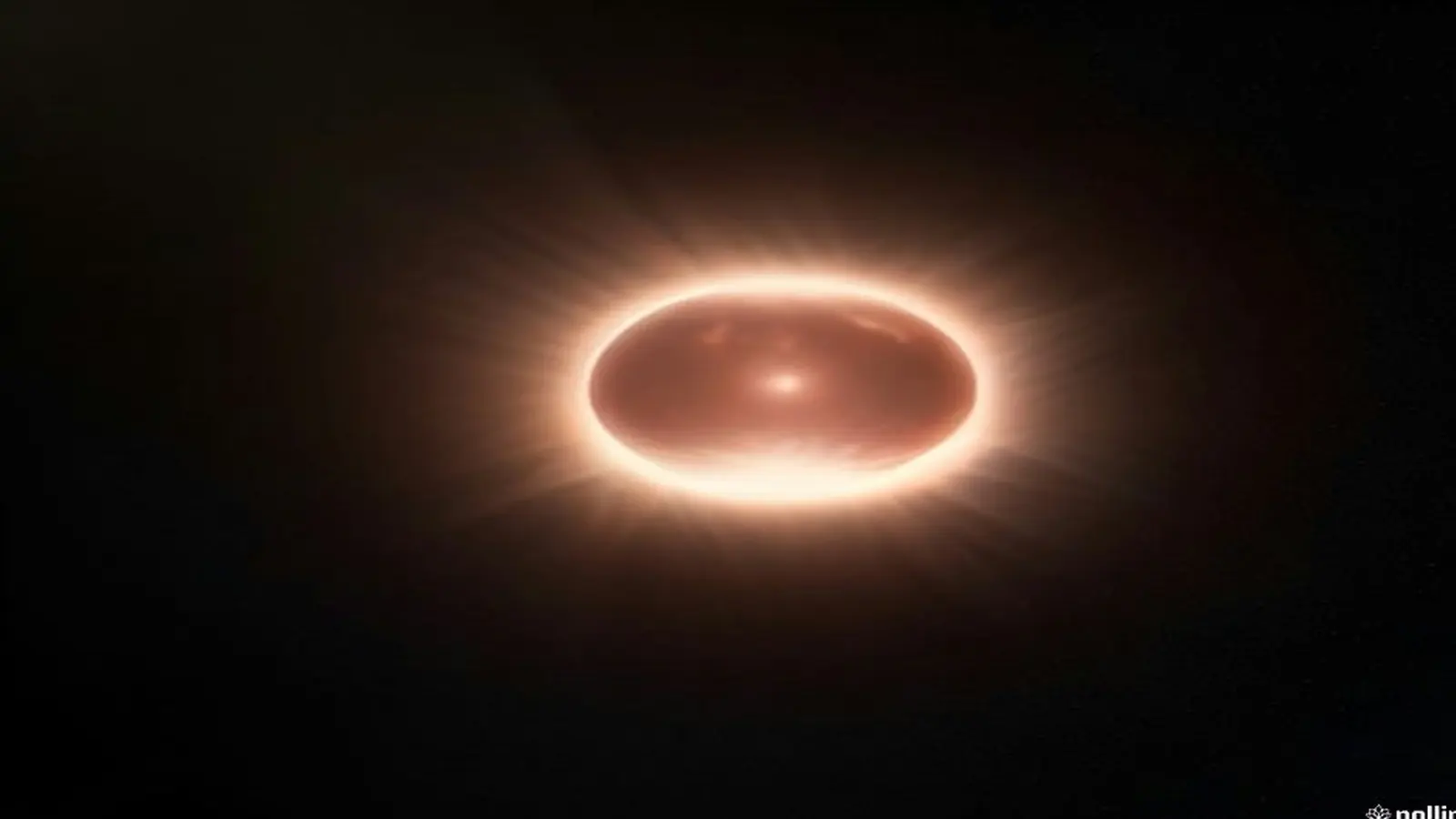
A Northwestern University team led by Rodrigo Ferrer-Chavez and Jason Wang presented FLIP (Physics-based Learning for Imaging Planets), a computational technique published in Nature on November 4, 2026. It combines a "digital twin" of the telescope with optimization tools similar to those used to train AI — without using AI to "recognize" planets — to model how light travels through the mirrors and subtract the glare more precisely.
Coronagraphs block much of the starlight, but a haze remains. For about 20 years, the usual fix was to subtract an image of a reference star. Any mirror wobble, even at nanometer or picometer scales, misaligns that template and leaves leftovers that hide faint worlds.
Reanalyzing JWST observations, FLIP improved sensitivity by 2 to 15 times. In two-year-old data of the star 51 Eridani, where the classic method could not see the giant planet 51 Eridani b at the carbon-dioxide wavelength, FLIP detected it at more than 5 sigma. CO2 in its atmosphere absorbs in that infrared band and weakens the signal further.
The technique could pull smaller, colder planets out of existing archives and help future missions such as the Habitable Worlds Observatory, which will search for Earth-like worlds.
Key facts
- Published in Nature on November 4, 2026.
- Sensitivity gains of up to 15 times over prior methods.
- Recovered 51 Eridani b in ~2-year-old JWST data.
- A planet can be a million times fainter than its star.
Every time we refine how we look, we discover the sky already held more worlds than we thought we could see.
Futurismo newsletter
Get the most futuristic stories in your inbox. Free.
By subscribing you agree to receive emails from Futurismo and our privacy policy. Unsubscribe anytime.Related stories
K2-18b: the signs of life that still don't convince
James Webb hinted at molecules linked to life, but later reanalyses don't confirm them.
A hidden star is plowing through Betelgeuse's atmosphere
Radio telescopes detect that a companion called Siwarha is distorting the red supergiant's atmosphere.
Mars is not dead: a giant volcano is still exhaling gas
The Trace Gas Orbiter detects hydrogen chloride over Alba Mons, a sign of ongoing igneous processes.
The Swift telescope will fall to Earth after a failed rescue
After almost 22 years hunting cosmic explosions, the NASA observatory is reentering the atmosphere uncontrolled.