What if 3I/ATLAS were an alien spacecraft? Avi Loeb raises the hypothesis
A Harvard paper analyzes, as an exercise, whether the interstellar visitor could be hostile.
A paper co-signed by Avi Loeb asks whether the third known interstellar object could be alien technology. Its own authors call it a pedagogical exercise.
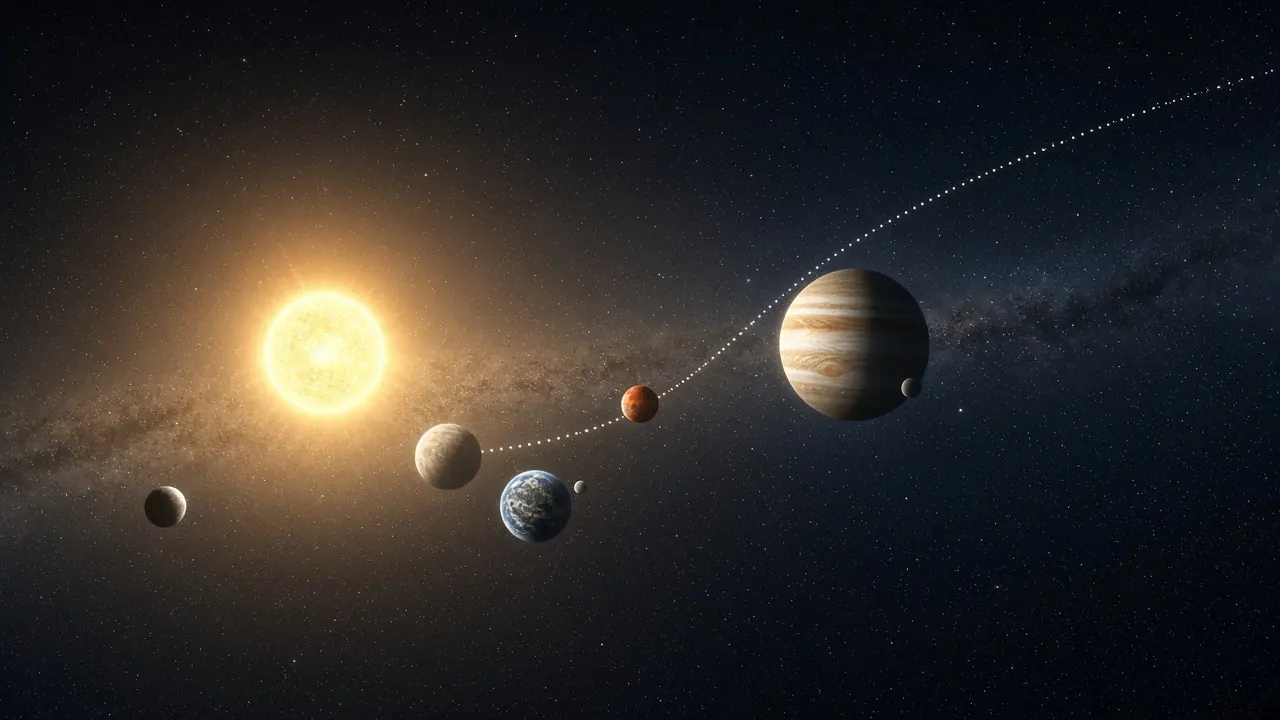
3I/ATLAS was discovered on July 1, 2025 by the ATLAS survey and is the third interstellar visitor detected, after 'Oumuamua and Borisov. Adam Hibberd and Adam Crowl, of the Initiative for Interstellar Studies, together with Harvard's Loeb, analyzed its trajectory and proposed a testable hypothesis: that it is a technological artifact.
They list oddities: its orbit is barely tilted relative to the plane of the planets, although it is retrograde; it passes surprisingly close to Venus, Mars and Jupiter, with an estimated probability below 0.005%; and at perihelion, on October 29, 2025, it was hidden behind the Sun as seen from Earth. They also propose tests, such as detecting non-gravitational accelerations.
However, the text itself acknowledges that these coincidences may be chance, that the human mind tends to see patterns, and that with only three interstellar objects it is hard to draw conclusions. Its conclusion is clear: 3I/ATLAS is most likely a natural object, probably a comet.
The paper is a preprint on arXiv, not peer reviewed. Its predicted close passes were Mars on October 3, 2025, Venus on November 3, 2025 and Jupiter on March 16, 2026.
Key facts
- Discovered on July 1, 2025.
- Estimated probability of its close pass by three planets: ≲0.005%.
- Perihelion on October 29, 2025, at 1.35 AU from the Sun.
- Later radio searches found no artificial signals.
The calculations can be applied to future interstellar objects detected by the Vera C. Rubin Observatory.
Futurismo newsletter
Get the most futuristic stories in your inbox. Free.
By subscribing you agree to receive emails from Futurismo and our privacy policy. Unsubscribe anytime.Related stories
An interstellar messenger to find Planet Nine?
An astrophysicist proposes using interstellar meteors to track the hypothetical planet.
The star cluster that is almost as old as the universe
A cluster hidden behind the dust of the galactic center may be 13.4 billion years old.
The Swift telescope will fall to Earth after a failed rescue
After almost 22 years hunting cosmic explosions, the NASA observatory is reentering the atmosphere uncontrolled.
The world's oldest computer tracked the lunar calendar
Gravitational-wave techniques solve a riddle of the Antikythera mechanism.