An interstellar messenger to find Planet Nine?
An astrophysicist proposes using interstellar meteors to track the hypothetical planet.
Planet Nine is still missing. A Canary Islands astrophysicist proposes searching for it with an unexpected tool: meteors arriving from outside the solar system.
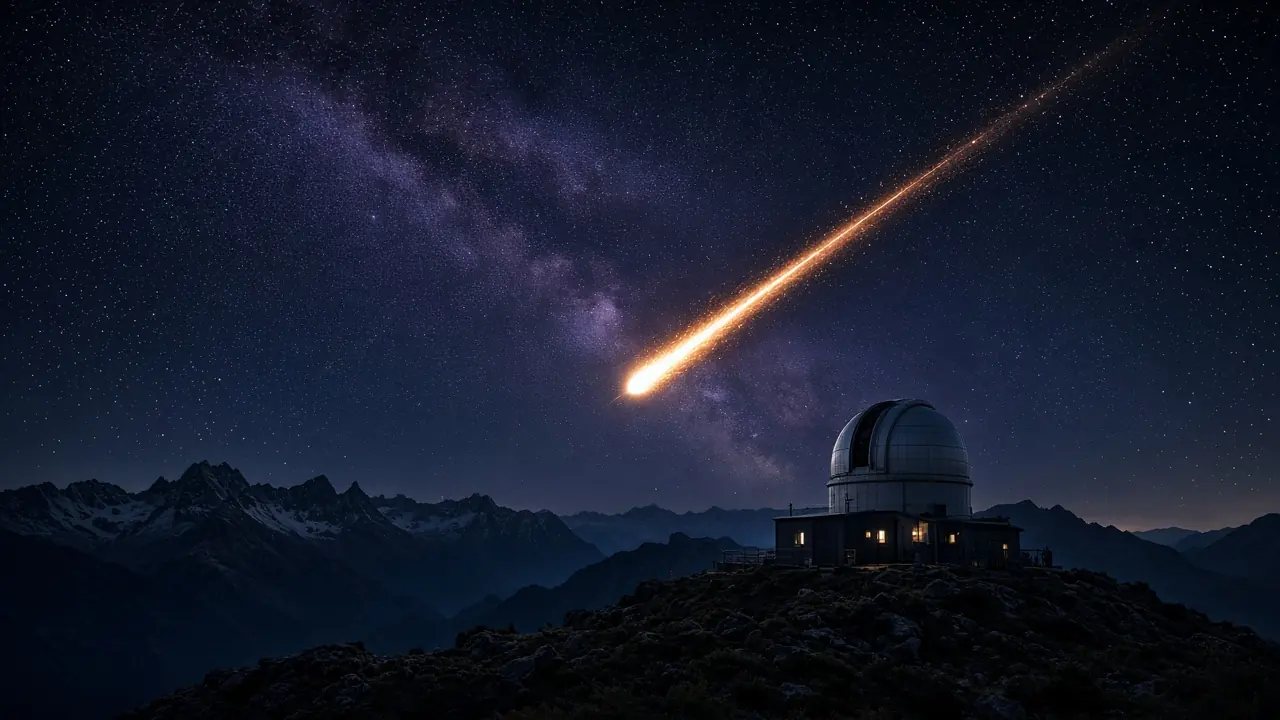
Planet Nine is a hypothetical world that, according to some astronomers, would explain the clustered orbits of certain distant objects beyond Neptune. It is estimated at 4 to 8 Earth masses, but no one has observed it directly.
Héctor Socas-Navarro, of the Instituto de Astrofísica de Canarias, published an original proposal in The Astrophysical Journal in 2023: if an interstellar object passed near Planet Nine, the planet's gravity would bend its path. By analyzing objects that later enter the inner solar system, its location could be inferred. As an example he used CNEOS14, a meteor that fell in 2014 off Papua New Guinea.
It should be taken with caution. CNEOS14's interstellar origin is debated, and Planet Nine's very existence is unconfirmed. The idea would require detecting many interstellar objects, something next-generation telescopes might make possible.
The method recalculates the meteor's trajectory backwards from the moment of impact, accounting for the gravity of the Sun, the planets and the Moon. Socas-Navarro generated 1,000 versions with small variations in velocity to measure the uncertainty. The result points to a region of the sky, 300 to 600 astronomical units away, that matches one of the areas proposed for Planet Nine. The author himself presents it as a possible candidate location, not a discovery.
Key facts
- Estimated mass of Planet Nine: 4 to 8 Earth masses.
- Proposal published in The Astrophysical Journal in 2023.
- CNEOS14 fell in 2014; its interstellar origin is disputed.
- No Planet Nine candidate has been found to date.
- 1,000 alternative meteor trajectories were simulated.
Telescopes such as the Vera C. Rubin Observatory could detect enough interstellar objects to test the idea.
Futurismo newsletter
Get the most futuristic stories in your inbox. Free.
By subscribing you agree to receive emails from Futurismo and our privacy policy. Unsubscribe anytime.Related stories
What if 3I/ATLAS were an alien spacecraft? Avi Loeb raises the hypothesis
A Harvard paper analyzes, as an exercise, whether the interstellar visitor could be hostile.

Mars is not dead: a giant volcano is still exhaling gas
The Trace Gas Orbiter detects hydrogen chloride over Alba Mons, a sign of ongoing igneous processes.
An algorithm uncovers a hidden planet in JWST data
FLIP boosts sensitivity up to 15 times by removing star glare and recovers 51 Eridani b.
A theorem strengthens the case that the universe had a beginning
Raphael Bousso extends a singularity theorem into the quantum realm.